What's New | ||
 | My gallery pages are long overdue for an update. It's my winter to-do. To see my new work, look on the example pages for my texture sheets.
| |
|
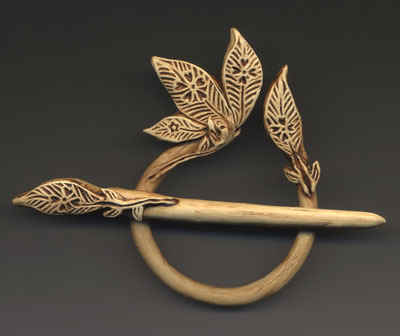
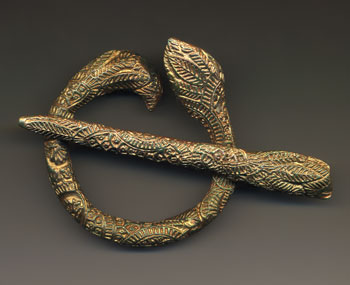
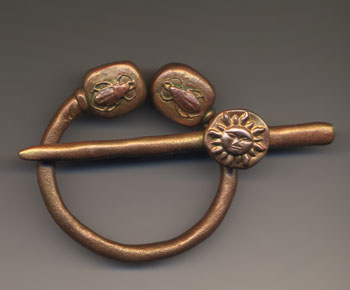
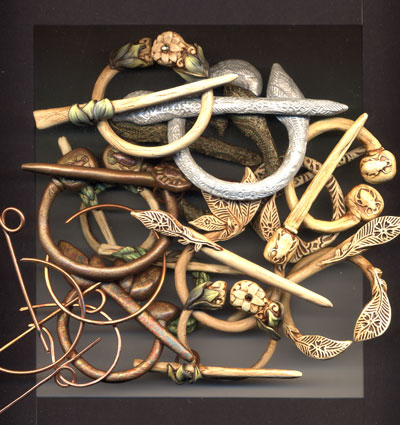
I taught a scarf pin class for my polymer guild Clayville California on February 12th. These are some of the many pins I did in preparation for the class. | |
|
|
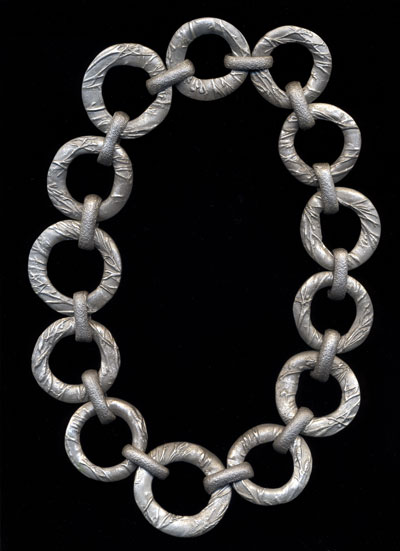
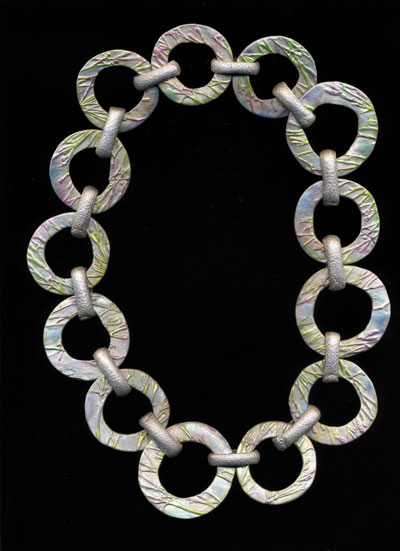
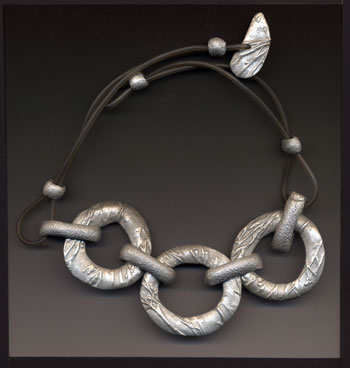
This piece isn't shown on any of my other pages. The chain is about 28 inches long. Each circle is about 2 inches across. The necklace is reversible. One side is silver and the other has pastel inks. Since I'm updating my workshop pages, I thought I'd throw in some new work on this page. I started this as a present, but it got a little BIG for the five foot tall recipient. Or perhaps, I got a little to fond of it, maybe. Below is the piece I made as the gift. It's about 17 inches, strung with a grey Soft Glass cording. It is also reversible, and a little more wearable. | |
|
Open Weave Basket
|
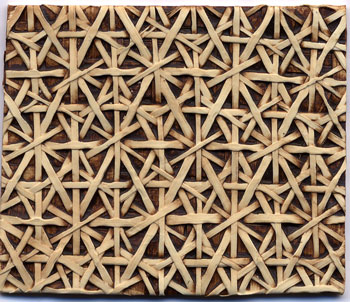
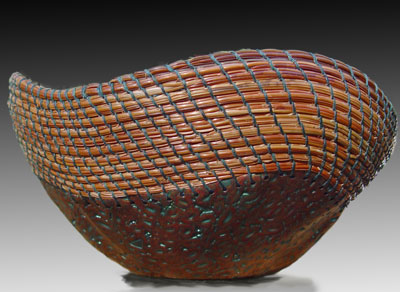
I've got two new texture sheets, Open Weave Basket and Crumpled Foil. You will find them on my Real Textures page, with a New flag. Open Weave Basket is molded from a bamboo basket. It's a very nice piece. The basket is two layers. The bottom weaving, (which doesn't show well in this example, the paint is on a little thick) is a plaited over two, under two twill. The top layer is the lovely open weave you see. There is a texture under the texture! Notice the detail, it is hard to believe this is just polymer clay pressed into a texture sheet with some brown paint. | |
|
|
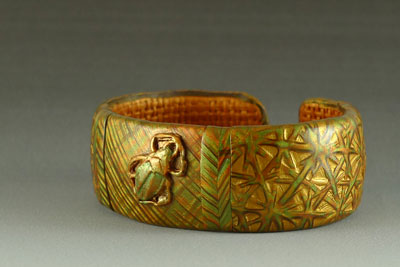
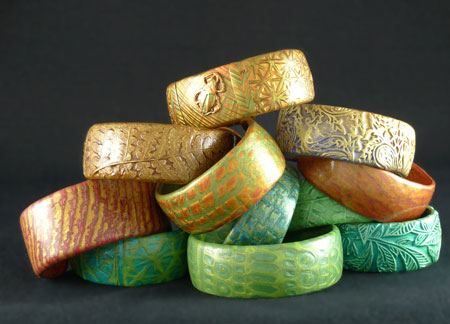
Here is a tinted gold mokume gane veneer on a brass cuff blank. For more images of this texture sheet in use, take a look at the example page; click here.
| |
|
Crumpled Foil
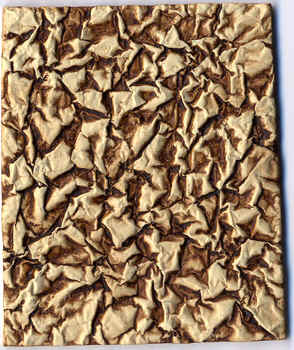
| Crumpled foil is just that... Yes, it's true....this texture sheet is molded from crumpled aluminum foil. A carefully manipulated and stabilized piece of foil, but still Aluminum Foil. Yes, you could just wad up foil and press it into something, but that's an impression, an inny, this is a mold of the actual thing, you get an outty. Look at this example, it is a great texture sheet, and versatile also. This ivory polymer clay with a Burnt Umber patina. Looks good, doesn't it. It looks more like leather or paper, very organic, very nice.
| |
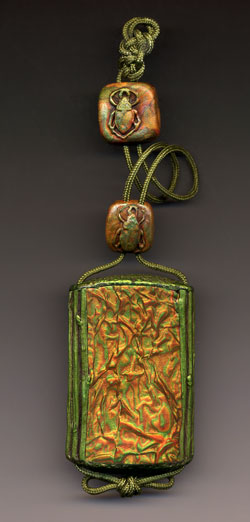 | I've used Crumpled Foil to create the
mokume gane veneer on the front. If you would like more information on the texture sheet mokume gane technique, here is a great tutorial on the web site Polymer Clay Central: Remember, the face of this piece is completely flat, the sense of depth is an illusion. For more images of this texture sheet in use, take a look at the example page; click here. | |
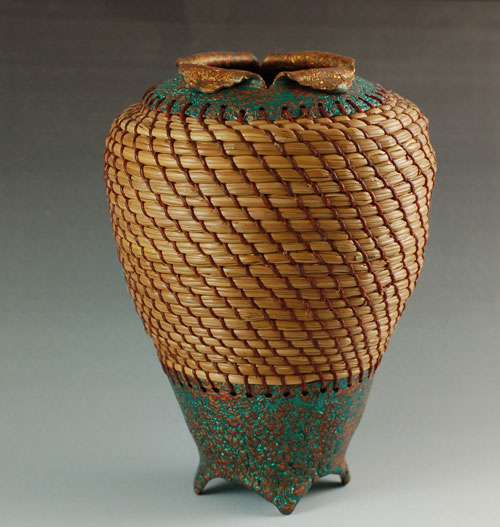 | Gallery Work This is my entry in the 'Synergy 2' exhibit, Exploring Connections. I was not able to attend the IPCG conference, but this little ( 5 1/2" x 4") basket was there. The exhibit chairperson, Marcia Laska, did a wonderful job of communicating, encouraging and planning. The IPCG is selling a catalog of the exhibit. Click here for the link:
| |
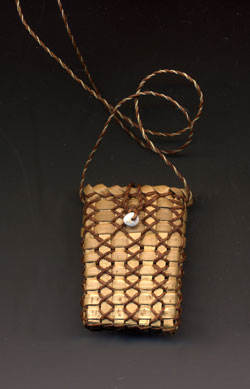
| I am a member of The Great Basin Basketmakers guild. The guild has a bi-annual exhibit 'Interwoven' at the Nevada State Museum. I've submitted these baskets. It's juried, so I will have to wait to see if they both get in. (actually there is a third one, a little lauhala pouch, slightly different proportions). It is a diverse group of basketry, 2010 will be our third show at the Museum. I love this show, and am always very excited to have a piece at the Museum. It is a beautiful exhibit. Basketry has such a history in this area. Our guild slogan says it all, 'Continuing 10,000 years of Basket Arts'.
The opening reception is the evening of March 25, 2010 at the Nevada State Museum, 600 North Carson Street, Carson City, Nevada
| |
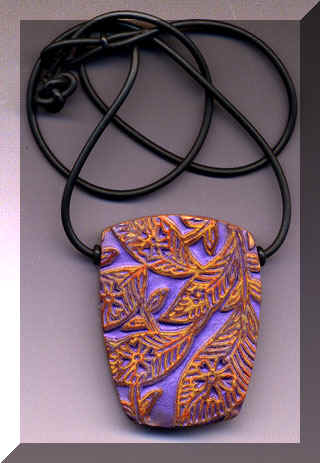 |
A few words about my texture sheets:I make each one of these individually, by hand, one at a time. Each one is molded from the actual object. Yes, I do sit out in the woods. I mix and sheet RTV silicon, then press it into the one special ancient fallen tree that has the best spot to take a mold of the subtle texture I call 'Weathered Wood'. For the textile block patterns, I make each one from the actual hand carved wooden block. Most of these blocks are not perfect, they have areas of wear or damage. I like this, I feel it gives them character and complexity. If you look at the 'Examples' page of 'Wood Block Two', you will see what I am talking about. This gives my texture sheets a very different effect than a mass produced rubber stamps or plastic texture sheets. Rubber stamps have either IN, or OUT. My texture sheets are that, 'Texture', whole mini-mountain ranges of variable depth. Even my sheets made from the textile blocks have variable depth. Look at those soft pillow shapes between the carvings, nice. I use a high quality, commercial, RTV silicon mold compound. These are thin, approximately 2mm, strong, flexible sheets. You can wrap them around your finger to impress just a small area or edge. They are thin enough to go through most pasta machines with a sheet of clay. They are silicon. You do not need a release agent. Things don't stick to them. This is wonderful and will spoil you. I love these texture sheets, I think you will too! This pendent is made is with 'Wood Block Four'. I'll add 'think of better names' to my 'to do' list.
| |
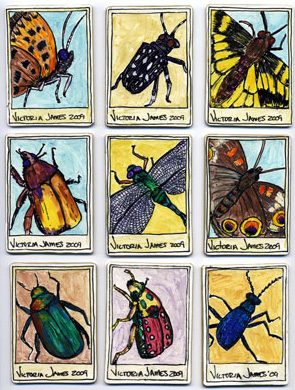 | ATC Swap Here are my cards for a local 'Artist Trading Card ' swap. They are made from two layers of polymer clay, plain white on one side, a decorative layer on the other side, and about 2.5mm thick. The fronts are painted. I used a Sharpie Poster Paint pen to do the outlines. The bugs are painted with acrylic paints, thinned to translucent with medium, and mixed with PearlEx to give them a nice buggy irradiance.
| |
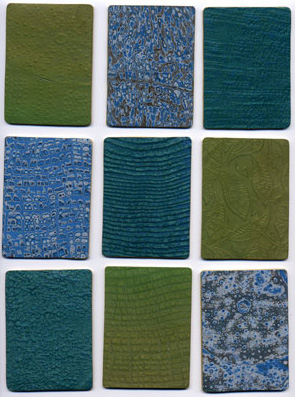 | The backs are done in a mica shift or texture sheet mokune gane. The olive green ones are mica shift. The top row, left, is a texture sheet I am still working on getting right, Sea Urchin. Middle row, right is Wood Block Four, and bottom row center is Shingle Cracked Growth Ring. The blue and yuck mokume gane are, top row Desert Sandstone, middle row Shingle Cracked Growth Ring, and bottom right, Sea Urchin. The teal blue ones are a three layer mix of Premo Blue Pearl, Green Pearl, and some scrap. I like using the metallic clay in a mokume gane, you get both color change and mica shift. It's hard to remember these are flat,. The sense of depth is just an illusion. Top row is Dark Side Wood, middle row center is Growth Ring, and bottom row left in Lava Rock. | |
 | Links and Info I should probably set up a links page, but I never seem to find the time to update my web site...so until then here are some links: Marie Segal has a great tutorial for sale on making bracelets. She had some great bracelets at Sandy Camp, one with my Lauhala my texture sheet: My local guild Clayville California , web site has new pictures on the 'members page': Thanks to Julie Picarello and Maureen Thomas for all their work for the guild.
| |